
From: https://www.parliamentwatch.ug
The Ministry of Health is requesting Shs100 billion (UGX100bn) in the 2026/27 financial year to operationalise the International Specialised Hospital of Uganda (ISHU) in Lubowa, as the long-delayed flagship project reaches 70 percent completion and targets full handover by December 2026.
Health Minister Dr Jane Ruth Aceng disclosed the funding bid while defending the ministry’s policy statement before Parliament’s Health Committee on April 10, 2026. The request forms part of a broader Shs668 billion increase in the health sector budget, lifting it from UGX4.487 trillion in 2025/26 to UGX5.155 trillion.
The move comes amid persistent questions over the project’s status, ownership model and spiralling costs. As of December 2025, the government had already committed US$209.1 million (approximately UGX771 billion) through 12 promissory notes, with an outstanding balance of US$170.6 million (UGX629 billion). Of this, promissory notes worth UGX142.3 billion are earmarked for drawdown in the coming fiscal year to complete construction.
MP Christine Nandagire (Bukomansimbi North) pressed the minister after noticing Lubowa’s absence from the official list of government health facilities. “The hospitals and all the institutions under the Uganda government were lined up here, but still I am not seeing Lubowa Hospital,” she said. “Is it fully constructed? Is Lubowa Hospital a government hospital or is it private? Which level is it – a Health Centre IV or a national referral?”
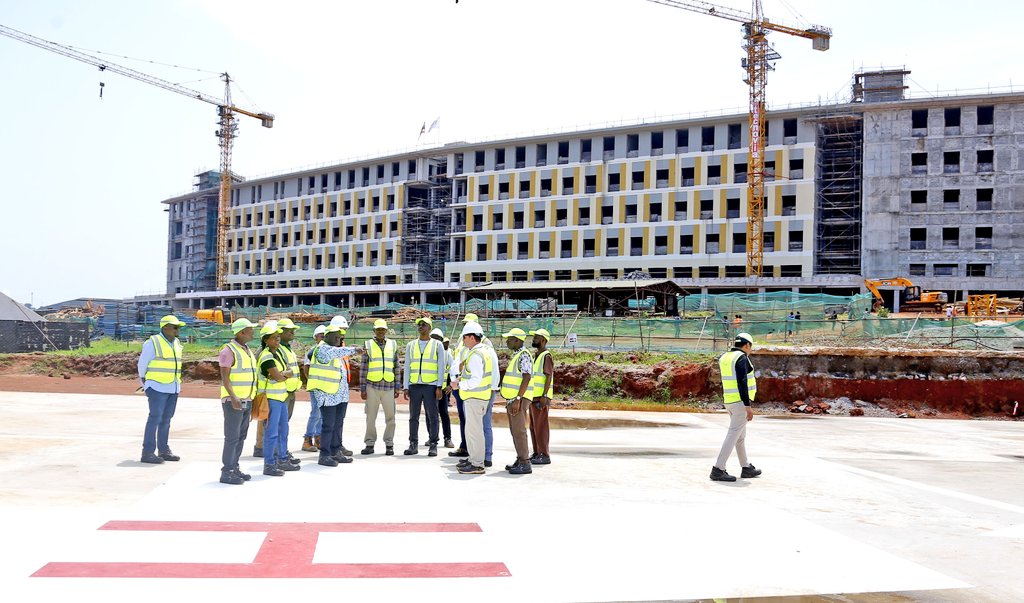
Dr Aceng responded firmly: “You asked whether it is a government facility. Yes, it is a government facility – a hundred percent government facility.” She confirmed recruitment and training of staff had begun, with public adverts already running. “We have now begun the programme of recruitment and training… When we start operationalisation, we need the UGX100 billion, which will cater for wages, utilities and other operational costs.”
On construction progress, the minister was candid: “Lubowa Hospital. Has it been completed? No. It is at 70 percent. The shell got complete, we roofed Lubowa, we have plastered. We are now doing final touches. That is why we need funding for operations – and it is good to plan early, because by the end of this calendar year, December, it will be complete and we need to start operationalisation.”
The hospital, designed as a 264-bed tertiary facility, aims to deliver advanced services including cancer treatment, organ transplants, cardiac, lung and kidney surgeries – reducing the outflow of Ugandans seeking specialised care abroad. It is being developed under a Public-Private Partnership (PPP) framework governed by the Public Private Partnerships Act, 2015.
An Italian-led consortium (Finasi) partnered with Uganda’s ROKO Construction under a government guarantee of US$379 million approved by Parliament in 2019. The private developer will handle initial operations for several years before full handover to the government.
The project has faced repeated delays since construction began in 2019, originally slated for completion in 2021, due to legal disputes, financing hiccups and parliamentary oversight. Multiple deadline extensions have drawn criticism over value for money, yet officials maintain it aligns with national goals for universal health coverage and infrastructure under the third National Development Plan (NDP III).
Dr Aceng used the committee appearance to outline other health-sector priorities in the 2026/27 budget, signalling a multi-pronged approach. These include Shs10 billion for the National Laboratory at Butabika, Shs10 billion for ambulance operations, Shs10.8 billion for X-rays and CT scans in general hospitals, and Shs20 billion to purchase new ambulances
Additional allocations target regional infrastructure: Shs58 billion to rehabilitate Masindi General Hospital, Shs26 billion for Hoima Regional Referral Hospital, Shs6.5 billion for Baseruka Health Centre IV ahead of the African Cup of Nations, and Shs4.5 billion co-financing for Entebbe Paediatric Hospital.
Longer-term plans include upgrading Wakiso Health Centre IV into a 300-bed general hospital (Shs234.3 billion over three years, starting with Shs55 billion in 2026/27) and elevating five KCCA facilities – Kisenyi HC IV, Kiswa HC III, Kawala HC IV, Komamboga HC III and Kisugu HC III – into city hospitals, with Shs50 billion allocated initially for Kisenyi and Kiswa.
While the Lubowa push highlights government ambition to modernise specialised care, it arrives against a backdrop of chronic health-sector underfunding. Uganda’s health budget remains well below the 15 percent Abuja Declaration target, with heavy reliance on donors and recent U.S. aid cuts adding pressure.
Critics argue resources must also address primary-care gaps, medicine stock-outs and human-resource shortages nationwide.
From: https://www.parliamentwatch.ug
