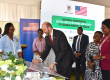
For Shaban Waigo Ogentho, 66, of Arua City, and Jesca Drakuru, 58, of Bileafe Sub-County in Terego district, life has taken on a new color after years of struggling with impaired vision.
Once unable to recognize faces or perform daily tasks, both now rejoice after successful cataract operations that restored their sight. Drawing parallels with the blind man in the Bible who asked Jesus to see again, Shaban and Jesca have become beacons of hope for others in their communities living with eye problems.
Shaban Waigo, a father and grandfather of ten, a peasant farmer, and LC 1 chairman of Madi Cell, Tanganyika Ward, Arua Central Division, recalled how his vision began deteriorating in 2020.
“I had been seeing well for 65 years, but this problem stopped me from seeing and doing my routine work for survival. I went to several clinics before being referred to Arua Regional Referral Hospital, where doctors discovered cataracts in my eyes,” Ogentho explained.
The cost of surgery—between UGX 80,000 and 100,000—was beyond his reach. “As I pondered how to raise the money, I heard about the free surgical camp. I immediately came to the hospital, was screened, and successfully operated on September 22, 2025,” he said.The impact has been transformative.
“I can now weed my crops in Arivu Sub County and write letters as LC 1, which I couldn’t do before. I’m deeply grateful to the Rotary Club for funding the operation. I can finally see again,” Ogentho added.
Similarly, Jesca Drakuru, a mother of four from Bileafe Sub-County, Terego district, described her ordeal. “My eyes became teary all the time in early 2025, and I could barely see anything. I stopped going to the garden and cooking, staying indoors instead. My family was worried because we couldn’t afford treatment,” she said in Lugbara.
Drakuru’s only son, Sydney Alionzi, took her to the free surgical camp after hearing about it on the radio. She was diagnosed with cataracts and successfully operated on.
“I can now see and perform daily tasks like gardening and cooking. I am grateful to the organizers and hope more such surgeries are held for others suffering similar problems,” Drakuru said.
Dr. Alex Candia, an ophthalmologist at Arua Regional Referral Hospital and coordinator of the surgical camp, said that these initiatives are crucial for vulnerable communities.
“Most patients cannot afford such operations. Free surgical camps allow us to address health challenges in poverty-stricken areas. We encourage partners to continue organizing them, especially in upcountry regions, as the response is always overwhelming,” he said.
Pauline Okoth, a Rotarian and one of the camp organizers, emphasized the humanitarian mission behind the initiative. “Helping vulnerable communities is a core goal of Rotary Clubs, and we will continue to pursue such ventures for the good of humanity,” she said.
The one-week West Nile Rotary D 9213 Surgical Camp, organized in partnership with the Association of Surgeons of Uganda (ASOU) and the Ministry of Health, screened 10,000 patients and performed 2,700 operations for ailments including cataracts.
Some beneficiaries traveled from as far as DR Congo and South Sudan, including residents of refugee camps in West Nile. For Shaban, Jesca, and thousands like them, the surgical camp has not just restored sight—it has restored independence, dignity, and hope.