
Date: Friday, 6th January 2026
Location: Busoga Sub-Region
Convener: Ms. Tausi Nakato
The Health Journalists Network in Uganda (HEJNU) convened a media health Café supported by CATALYSTS Consortium Project, bringing together over 20 journalists, health experts, and activists from print, broadcast, and digital media. The event provided a lively platform for in-depth discussions, knowledge sharing, and collaborative learning on critical health issues.
Key Presenters and Participants
Dr. Aggrey Bameka – Gynecologist & Obstetrician attached to Buwenge General Hospital in Jinja District ; Eastern Region President, Association of Gynecologists and Obstetricians of Uganda; Coordinator, Busoga Local Maternity and Neonatal System.
Mr. Paul Watuwa – Lawyer, Jinja High Court; Veteran Media Editor, New Vision.
Ms. Nuulu Nambazira – Health activist and unsafe abortion survivor.
Objectives of the Media Café
Strengthen journalists’ understanding of maternal mortality, unsafe abortion, and post-abortion care (PAC).
Build knowledge on Uganda’s abortion laws, legal exceptions, and human rights frameworks.
Promote accurate and responsible reporting to reduce stigma and misinformation.
Advocate for rights-based, safe abortion and post-abortion care services.
Highlight the importance of family planning and post-abortion family planning to reduce unintended pregnancies.
Enhance reporting on health system challenges and promote accountability.
Encourage media-led awareness campaigns for reproductive health and harm reduction strategies.
Presenter Highlights
Dr. Aggrey Bameka – Clinical and Maternal Health Perspective Maternal Mortality & Unsafe Abortion
Maternal mortality in Uganda: 189 per 100,000 live births.
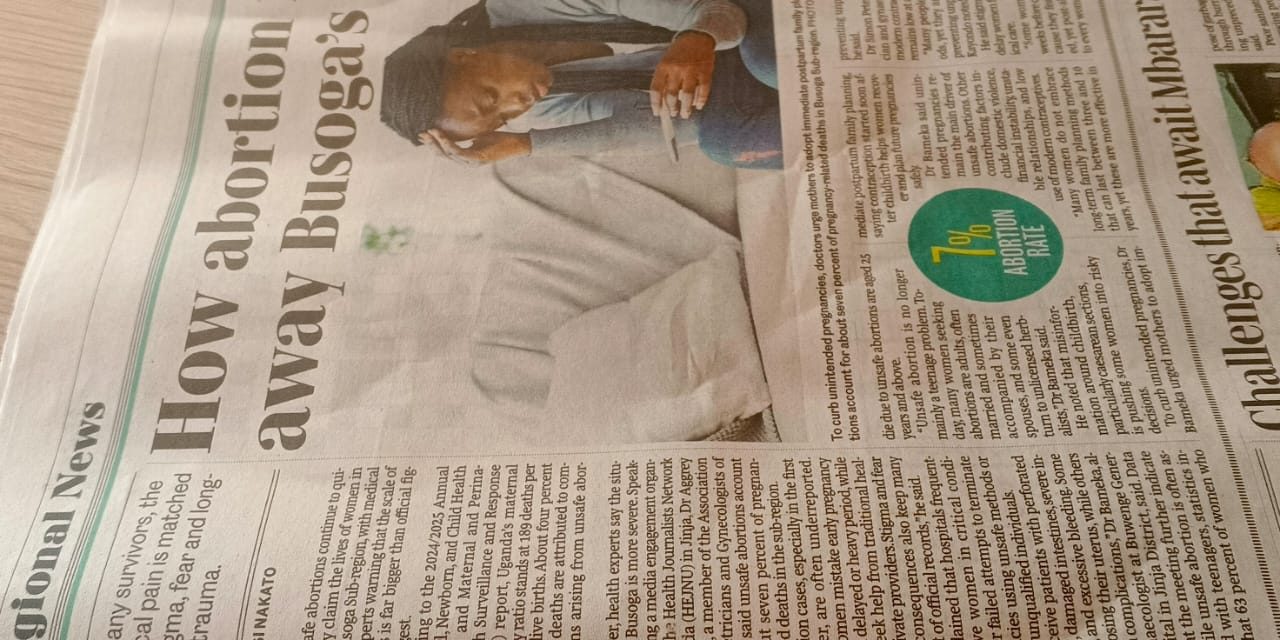
Unsafe abortion contributes to 4% nationally, 7% in Busoga.
Common complications: uterine and intestinal perforation, infection, hysterectomy, death.
Most affected women (63%) are aged 25 years and above.
Abortion & Pregnancy
Abortion: termination before 26 weeks.
Delivery: birth at 26 weeks or later (live birth or stillbirth).
Early pregnancy losses often go unreported due to stigma and legal restrictions.
Causes of Unsafe Abortion
Stress, unplanned pregnancies, domestic violence, financial constraints.
Limited use of long-term contraceptives; reliance on short-term methods.
Use of herbs or unlicensed clinics leads to severe complications.
Post-Abortion Care (PAC) & Family Planning
PAC includes: emergency management, counseling, family planning, infection screening.
Immediate postpartum family planning prevents unintended pregnancies, even after cesarean or complicated deliveries.
Harm reduction approach: provide support without judgment, link women to medical and social services.
Mr. Paul Watuwa – Legal and Media Perspective
Circumstances Under Which Abortion is Permitted:
When the mother’s life is at risk.
When the pregnancy results from rape or defilement.
When the fetus has life-incompatible abnormalities.
Key Legal References:
Penal Code sections: 41, 42, 143, 212, 224./Constitution of Uganda: Articles 22(1) & 22(2).
Highlights:
Section 224 protects qualified medical practitioners performing abortion in good faith to save the mother’s life.
Article 22(1) guarantees the right to life; no person shall be deprived of life except through due legal process.
Article 22(2) states that abortion is illegal except as authorized by law.
Section 41: Procured miscarriage by a third party – imprisonment up to 14 years.
Section 42: Woman self-administering abortion – imprisonment up to 7 years.
Section 143: Unlawful supply or procurement for abortion – imprisonment up to 3 years.
Section 212: Killing an unborn child – life imprisonment.
Context:
Abortion is considered a reproductive right under human rights and feminist perspectives, giving women autonomy over pregnancy decisions.
Cultural and ethical perspectives recognize the involvement of the father and society, emphasizing a balance between individual rights and social
responsibility.
The law allows exceptions for maternal health risks, rape, defilement, fetal abnormalities, and severe complications.
Role of Media:
Report accurately and responsibly to reduce stigma.
Educate the public on women’s reproductive rights and legal frameworks.
Advocate for safe abortion, post-abortion care (PAC), and policy reforms.
Promote harm reduction strategies and family planning awareness..
Ms. Nuulu Nambazira – Survivor & Activist Perspective
Ms. Nambazira shared her personal journey during the COVID-19 pandemic, recounting the severe complications she experienced after attempting an unsafe abortion resulting into fetal death and heavy bleeding.
While still attending school, she faced peer influence and spent time away from school, engaging with friends, which ultimately led to an unplanned pregnancy.
She first realized her pregnancy after missing her periods and confided in her sister, who conducted a home pregnancy test.
Fearful of her parents' reaction, she delayed seeking formal medical care, enduring isolation and abuse at home. With no financial means to access hospital care and fearing stigma, her sister, following advice from colleagues, gave her herbal medicine intended to terminate the pregnancy.
After two months, she experienced no improvement but began suffering severe abdominal pain. By the third month, her health deteriorated, and she collapsed. She was taken to Bugembe Health Center IV, where it was discovered that thefetus had died. She was then referred to Jinja Regional Referral Hospital, where surgical intervention was performed to save her life. The ordeal left her physically weakened and financially drained. Her testimony highlighted the urgent need for accessible, safe abortion services, post-abortion care, counseling, and supportive networks to prevent women from enduring similar trauma.
Conclusion
The Health Café successfully:
Provided journalists with knowledge and practical tools to report on abortion and PAC responsibly.
Encouraged media advocacy for legal clarity, reproductive rights, and maternal health. – Highlighted the importance of family planning and harm reduction approaches.
Strengthened collaboration between journalists, medical experts, and activists to improve reproductive health outcomes in Uganda.
Key Takeaway: The event reinforced the media’s critical role in shaping public understanding, reducing stigma, and influencing reproductive health policies.
Stories generated:
